🚨 GOP Leaders CONSPIRE AGAINST Trump BEHIND HIS BACK
Full Transcript
🚨 GOP Leaders CONSPIRE AGAINST Trump BEHIND HIS BACK
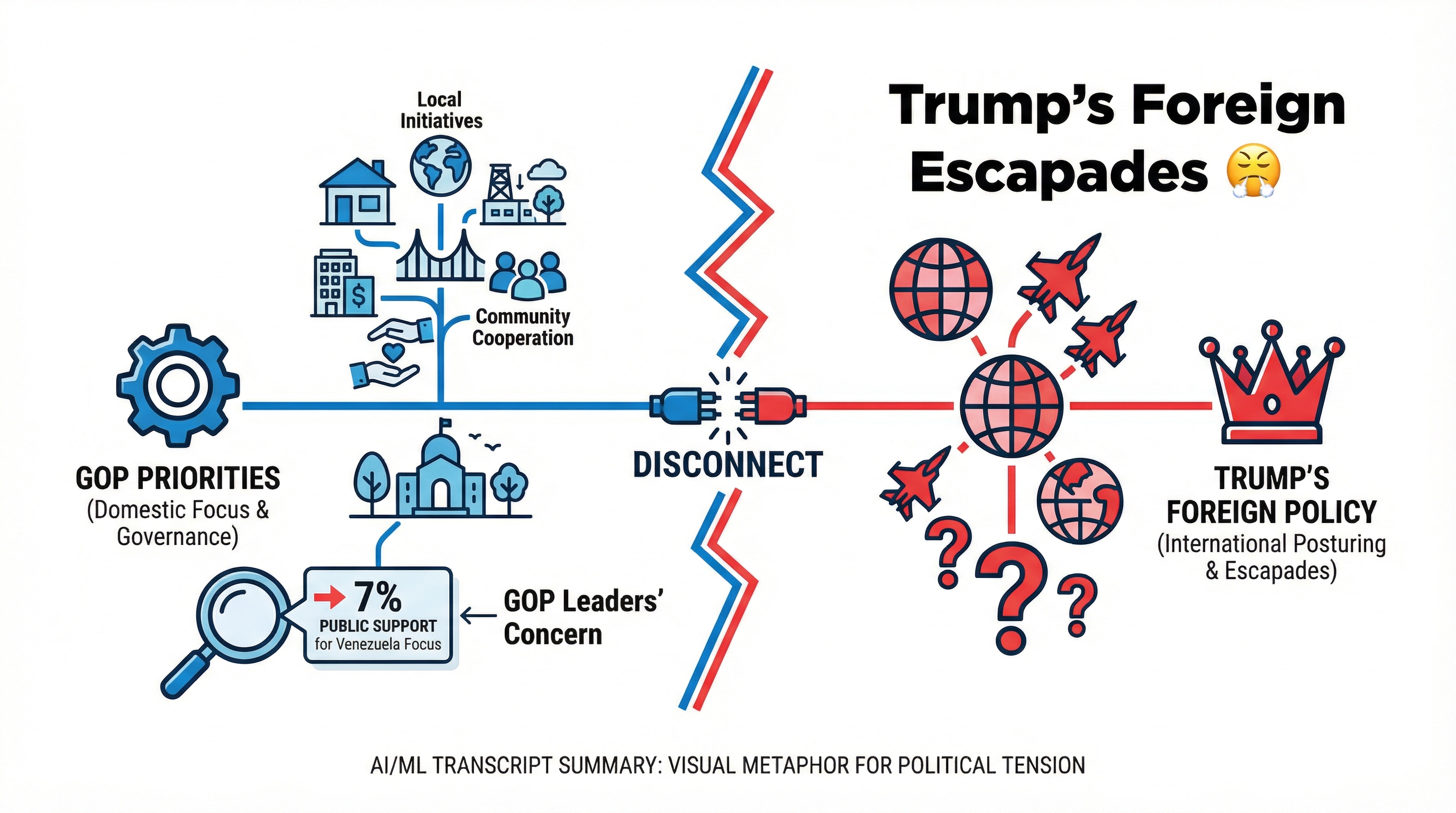
[00:00] Republican lawmakers, senators, and Congress members alike have been inundating the White House, and specifically Donald Trump's chief of staff with calls, yelling at her and yelling at this regime. Republican lawmakers are yelling at them for focusing on running Venezuela, and the polling from UGov and any other legitimate polling agency is showing that overwhelmingly 60, 70, 80,
[00:03] of American people based on how these questions are asked do not want the United States running Venezuela. Should the United States prioritize Venezuela over America? It's like only 7% of people support that. And I guess in that 7% is Donald Trump and his cabinet who keep talking about we're running Venezuela. It's our country now. Delci Rodriguez does what I tell her to do.
[00:06] We're the predator Donald Trump says and Republican lawmakers are like hello This is an election year. This is 2026 and right now you keep talking about invading Greenland and you keep talking about Running Venezuela and how Colombia and Cuba and Mexico are next the American people hate this and the Republicans are getting Massive backlash here's the latest from Reuters that has a great scoop on this after
[00:09] After the president announced on Saturday that US would run Venezuela, Republican lawmakers inundated the White House with calls, insisting the only country Trump should be running right now is the United States. Stop with the Venezuela stuff. The article goes on to talk about how Susie Wiles has been basically trying to convince Donald Trump that keep on talking about Venezuela is not a winning issue. The article goes on to say, top White House aides are openly
[00:12] frustrated that Trump and senior officials continued to talk about foreign affairs and taking over different countries and that they're not talking about affordability. It goes on to talk about in multiple White House meetings focused on the economy since November, Donald Trump always pivots to talk about his personal grievances. And then he just puts out a bunch of lies about the economy. And people are just fed up about this. It goes on to say,
[00:15] Republicans on Capitol Hill have privately questioned, why is Trump not more focused on domestic priorities at all? He needs to stay focused on things that voters care about, not renaming buildings and other things that are not in the kitchen table category. They then talked about that Donald Trump did this retreat at the Kennedy Center, which Trump vandalized and called the Trump Kennedy Center. And Republicans have referred to it as an 84-minute speech wandering through his grievances.
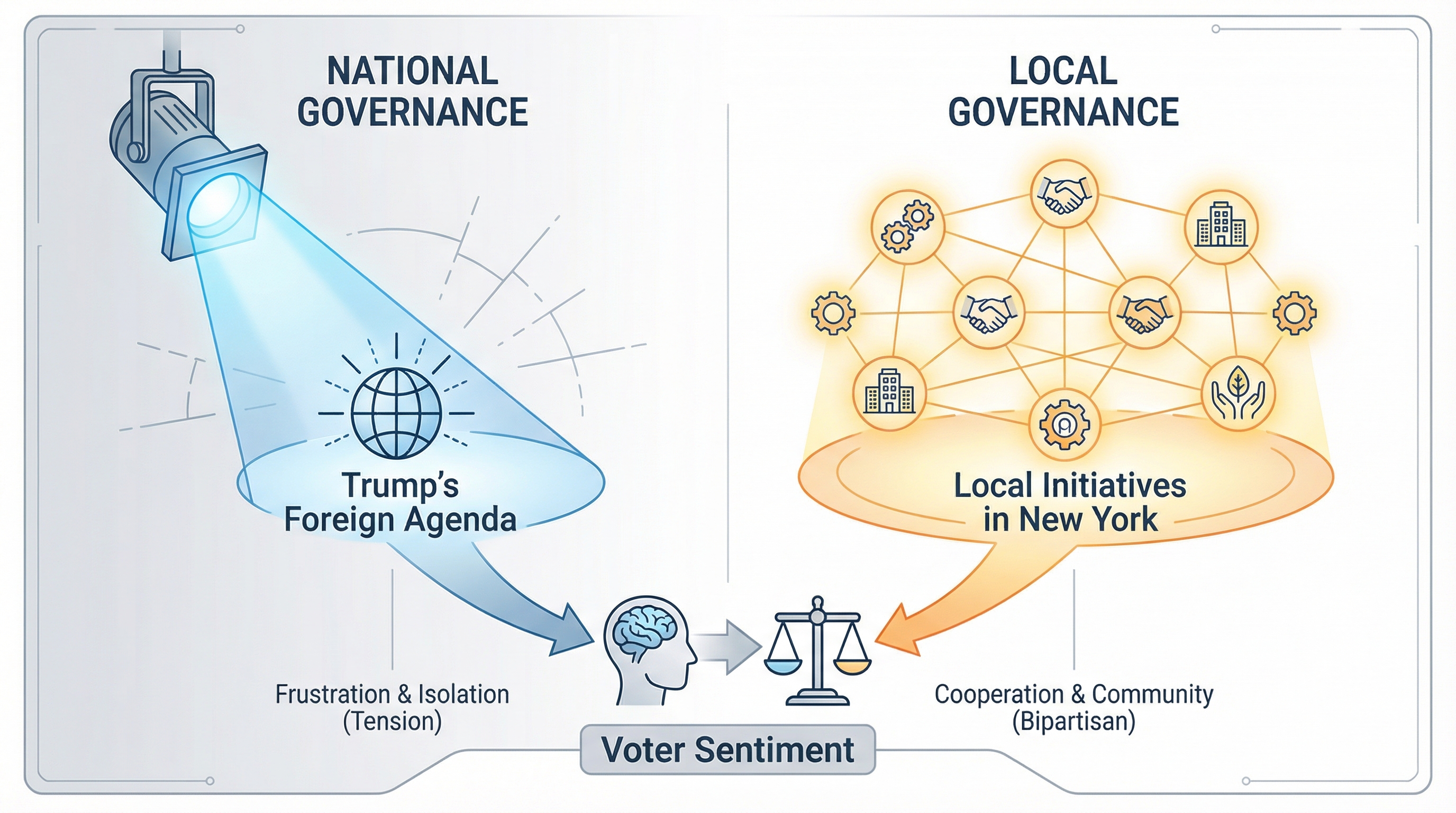
[00:18] and cultural war issues. And it goes on to talk about how the MAGA coalition is being ripped apart and how people just do not want to see this crap. Now, contrast this, contrast this. And this is one of the fears that the White House has. Contrast this to what is taking place and just say New York, right? In New York, you have Zoran Mamdani, the New York City mayor,
[00:21] forces with Kathy Hokel, the New York governor, to extend child care services to hundreds of thousands of more children, to extend the idea and to try to make the reality of universal child care a possibility in New York. More work needs to be done there, but in eight days, Zoran Mamdani does this announcement with Hockel to actually deliver for the people of New York.
[00:24] before you know politics is often talked about in these gamified ways this personality that personality who's winning who's losing this person said this about this person kind of like high school right but like a high school on steroids and also really freaking weird okay but as I've said take a step back and ask yourself what is this government doing for the people because that's what the government's supposed to be by the people for the people
[00:27] not for the billionaires and for the bullies, not the ice Gestapo on the street, healthcare, education, housing, affordability, quality of life, people get paid with dignity. That's the stuff that we should be focusing on. So Donald Trump was asked a question about Mom Dani. Did you see this at one of his bizarre pressers? And he's like, yeah, he took a shot at me on Venezuela, this guy here playing this clip.
[00:30] or mom donnie well we're going to find out your favorite mayor well i have a very nice relationship but i thought it would take it at least maybe a month or two months before he went after me he he hit me on uh the attack on venezuela which is pretty unusual because not too many people have hit us that was a perfect attack i want to bring in it's a special guest new york city mayor
[00:33] I was just talking about all of the, the weirdness, the distractions, the ballrooms, the chaos, the utilizing government to attack the people that we've been seeing in this Trump regime. And you mayor, in a very short period of time, you've kept to your word, and you've delivered for the people of New York childcare, right? What is the cost of childcare? $22,000, $25,000 per family.
[00:36] top of that health care costs, 22 to 25,000. Child care, health care alone, $50,000. Who can afford that? Who can afford that? So Mayor Mamdani, talk to us about what you and Governor Hokel did. Now, Governor Hockel is often viewed more. I mean, this is how she's talked about. You know, she's viewed more as kind of a center left. You're viewed obviously more progressive, Democratic Socialists. Coming together, though, for the common good
[00:39] This is what people want to see. So while it seems like Trump and the federal government are focused on $100 billion in subsidies for oil companies and unlawful invasions of Venezuela, if you look at New York, it's actually delivering for the people and right away in New York City. A big announcement from the mayor, Zoran, Mamdani and Governor Kathy Hokel in this joint press conference, we started seeing a post from Governor Hockel, universal child care is coming to New York. That's refreshing to hear right there from the governor of New York.
[00:42] Did it again. Universal childcare is coming. Universal child care. The big announcement today, moving New York City closer to Zoran Mamdani, the mayor of New York City's vision for universal child care. So it just seems that in all this bad news, the deluge of it, that seems to be just kind of flooding the news cycle, you are keeping your word and you are doing things for the people of New York City and joining forces with the governor. And you know, it's an interesting.
[00:45] Just thing they pull in people from different sides of the left and progressives, joining forces for something that benefits to people. Tell us about it, Mayor. Well, it's truly lovely to be back on here with you. And what I would say is that it is, as you've said, today is an incredible win for working people. We're talking about a $1.2 billion commitment from the state of New York to the city of New York to make universal childcare reality. This is money that will mean that we can fix child care for three-year-olds across the city, and we can
[00:48] care for every two-year-old across the city. And after housing, child care is the number one crisis facing working families in the city. It's the number one reason that they're leaving this city. And that's because the average cost of child care is $22,500 a year. And so what today's commitment and today's partnership between the governor and myself shows is that working families are not going to have to make the choice any longer between the city they love and the family they want to actually raise. I alluded to this to, and alluded to this in my intro, that you and Governor Hockel are
[00:51] perceived as very different kind of Democrats. But you're delivering this together and joining forces on this together. And so can you speak to that also? Because I know there are lots of people who like to kind of push the divisions, but there are ways to work together for the greater good of the people. Absolutely. And I think what we have found is that the same thing that we see in conversations with the New Yorkers. New Yorkers rarely ask me how to describe my politics. More often they ask me if my politics,
[00:54] includes them. And what we're seeing from both the governor and myself is a focus on the outcome of actually delivering for working families. The governor had said that 2026 would be the year of childcare. We ran a campaign 14 months speaking about the importance of delivering universal childcare. And now together, the two of us are showing, in her words, that the era of empty promises is over. And what we are doing is delivering for the very families who had been considering leaving this city and showing them that it's actually going to be easier to raise their kids
[00:57] You know, and this is eight days, right, into the administration. And, you know, there were lots of people who were saying, this couldn't be done after the first year or two years or this. So I think you're also sending a message for all the people who were saying, well, you know, progress is going to be slow and it's not, it's not going to, this stuff wasn't feasible that he said. This was just campaign stuff. What do you say to them? I think we are showing them that politics can be different than what it has been. We are showing them that.
[01:00] when we dare to dream of a world that is better than this, that's the first step in not just fighting for it, but winning it. And today's victory is frankly a testament to the more than 100,000 people who made millions of phone calls over the course of that campaign who knocked on millions of doors and spoke to so many New Yorkers about their dream of a city that they deserved. They willed this day into existence because as you said, there were so many who told us that we could never get here, but in the words of Nelson Mandela, it always seems impossible until it's done. And today is that first step.
[01:03] to ensuring that we deliver universal childcare for each and every New York. You know, 2026 midterms are on the mind of people. I mean, not on your, your minds run in New York City, but there are lessons, I think, that can be learned. I mean, do you think that Democrats looking at 2026 should be taking lessons from the fact that you ran on a big plan and now in week one, you're delivering on a big plan and your intentions to keep on doing that? You know, I think there is something to say that a lot of New Yorkers have lost faith
[01:06] in democracy not because of losing faith in the ideal of it but rather losing faith in its ability to deliver on their material needs as working class individuals and what we're seeing right now is that if you lay out a vision that matches the scale of the crisis at hand and then you deliver on that vision you will see far more New Yorkers looking at politics as something that is relevant to their day-to-day lives as opposed to something that they should take as much distance as they can from and i think that's the case across this country where so many are asking themselves is there an answer to the
[01:09] And what we're showing here in New York City is when it comes to childcare, there is. And now the agenda continues, the work continues, because each and every day is going to be focused on how can we take on the cost of living crisis that has made this the most expensive city in the United States of America? Anything in the first eight days that you didn't expect that you've said, wow, that's something that, you know, or is there anything like that that you just reflect on now eight days in that is, that may be intriguing.
[01:12] or that people aren't thinking about. Well, you know, I think especially speaking to you today when we've accomplished such a significant part of what was one of the cornerstones of our campaign, there's a temptation to think that governance is only about the issues that are as large as our city, when in fact, governance is also about showing that there's no issue too small. And a few days ago, I was sitting around our conference table with our cabinet, and we were talking about the different things that we could be doing in our first hundred days. And I brought up an example of something that has afflicted a lot of New Yorkers'
[01:15] especially cyclists when they're biking over the Williamsburg Bridge and they come into Manhattan, there tends to be this drop that they experience. And I've experienced it myself as a cyclist every now and then. And I asked, you know, how can we fix this? What can we do? And the answer was, well, we could just do that tomorrow. So why don't we? And I think that's what we're showing is, in fact, if you care about working class New Yorkers, if you care about their needs, whether big or small, you can start to deliver on them. And that's been something that's been so exciting about governing is that we are now in a position to deliver for New Yorkers,
[01:18] on what we would do if we had that power. Well, Mayor Mamdani, in a 2026 where we keep hearing stories about threats of invading Greenland or buying people off for $10,000 or $100,000 in Greenland or invasions of the Western hemisphere and this regime bragging about being a predator in the Western hemisphere, I think the American people just want to be like, what are you doing for us? Like, what are you doing for the American people? Enough about 40 billion to Argentine?
[01:21] And Dina and this, like, what are you doing for us? I'll just give you the final. I give you the final word to just reflect on this moment. But I think the people are like, hey, America, us here, we want to live in homes and afford rent. Yeah, I mean, it's it's the question that most people will ask you is, you know, are my struggles actually a part of your politics? Are my day-to-day realities reflected in what you are working on? And too often politics doesn't feel like a reflection. It feels as if it is an inverse of what people are living through.
[01:24] And what we've found is that the best way to deliver for New Yorkers is to start by listening to them. And after the housing crisis, New Yorkers will tell you it's the child care crisis. It's a crisis where in a city, it's cheaper to send your kid to college at the city University of New York than it is to find childcare for that same child. And today we are showing that we are actually going to deliver the city that New Yorkers deserve and we're going to do that by making it easier, making it more affordable to keep calling the city your home. And it's truly an honor to be a part of this movement. It's truly an honor to be leading.
[01:27] this fight to ensure that our neighbors can keep calling themselves exactly that. New York City mayor, Zauron Mamdani, great to see you, great to have you as the mayor of New York. Thank you so much, my friend. All the best. Everybody hit subscribe. Let's get to six million subscribers. Want to stay plugged in? Become a subscribers for our substack at Midasplus.com. You'll get daily recaps from Ron Philpikowski, add free episodes of our podcast, and more exclusive content only available at Midasplus.com.
[01:30] I'm going to be.